
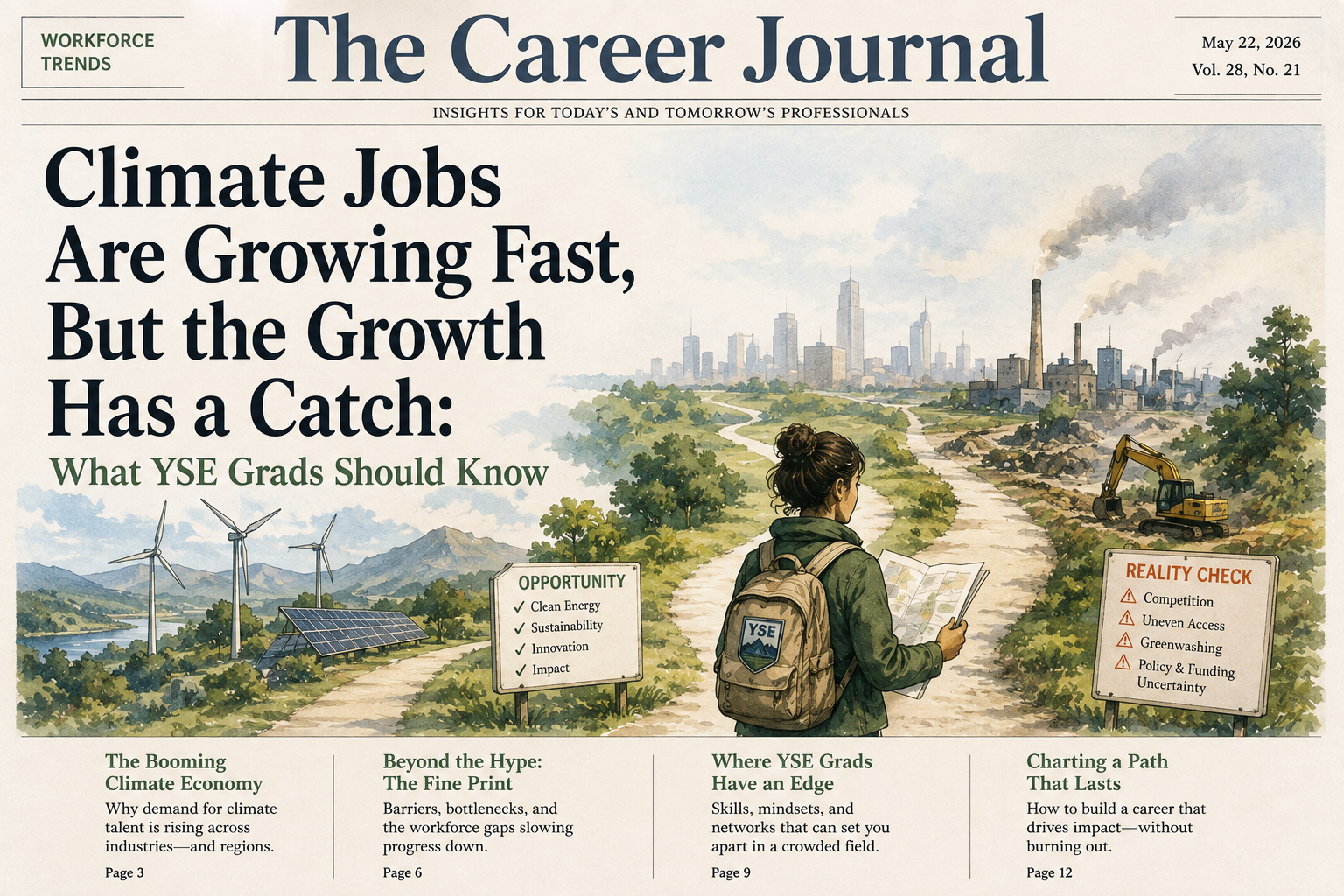
 Yale’s own career office puts it plainly: climate sector jobs are growing fast, but much of that growth comes with a catch that trips up plenty of qualified candidates. This piece looks at what the Yale School of the Environment’s forestry, climate policy, and urban sustainability programs actually offer graduates right now, and how new initiatives like the Bekenstein Climate Leaders Program are specifically designed to bridge the gap between environmental training and a genuinely sustainable career.
A Growing Field With a Real Catch
Yale’s own Office of Career and Professional Development doesn’t sugarcoat the climate job market: jobs in the sector are growing, and growing fast, but much of that growth has historically concentrated in roles requiring years of specific experience, creating a genuine bottleneck for early-career professionals who feel trapped by a single line in a job description asking for experience they haven’t had the chance to build yet. YSE’s career resources specifically address this with a skill-first framing, helping students understand how to get hired in 2026 without years of prior experience by emphasizing transferable, demonstrable skills over credential checklists alone.
Founded in 1900, YSE has spent more than a century training environmental leaders, and its current focus areas, energy policy, ecosystem science, hydrology, urban science, green chemistry, and environmental justice, reflect a genuinely broad, interdisciplinary approach to a field that increasingly touches nearly every sector of the economy.
What This Means by Specialization
Forestry (The Forest School)
Forestry remains one of YSE’s founding and most distinctive specializations, and the school’s new Executive Master of Forestry program, launching its first cohort in August 2026 for professionals with at least a decade of experience, reflects genuine industry demand for advanced forestry leadership training. For students earlier in their careers, the traditional Master of Forestry degree connects to roles in sustainable forest management, conservation organizations, and the timber and land management industries.
Climate Policy and Energy
Climate policy and energy specializations sit at the center of YSE’s curriculum, and the Bekenstein Climate Leaders Program, launched specifically to make high-impact climate careers in government and the nonprofit sector more financially accessible, combines scholarships, internship stipends, and postgraduate incentives for students committed to climate change mitigation work. This program directly addresses one of the most persistent challenges in climate careers: many of the highest-need government and nonprofit roles pay considerably less than private-sector alternatives, and Bekenstein’s financial support structure is designed to make those lower-paying but high-impact roles genuinely viable for graduates.
Urban Sustainability
YSE’s Urban Climate Leadership certificate program, launched in 2024 through the Hixon Center for Urban Sustainability, prepares urban policymakers and practitioners specifically to implement climate solutions at the city level, a genuinely distinctive credential for students interested in municipal government, urban planning agencies, or city-focused sustainability consulting rather than federal or international climate work.
GIS and Environmental Data Skills
The Yale GIS Accelerator, an intensive hybrid training program, reflects how central geospatial and data skills have become across environmental careers broadly, not just in traditional GIS-specific roles. Students across every YSE specialization should treat GIS and broader environmental data literacy as a genuine differentiator, given how frequently these skills appear as requirements across climate, forestry, and urban sustainability job postings alike.
Structured Pathways Into the Field
For current students, the Environmental Fellows Program places graduate students in mainstream environmental organizations, nonprofits, social justice organizations, philanthropic organizations, environmental media outlets, policy think tanks, governmental institutions, and grassroots environmental organizations for a 12-week summer placement, with a competitive $15,000 base stipend plus additional travel and housing support. This structured, funded pathway directly addresses the experience bottleneck YSE’s own career office has identified, giving students genuine, paid professional experience at exactly the kind of organizations that typically require prior experience to enter.
Students should also monitor opportunities like the Carbon Containment Lab’s research internships, which connect students directly to applied greenhouse gas reduction and containment work, another genuinely hands-on pathway into a specific, technical climate niche.
What People Actually Say
YSE’s own six-months-post-graduation employment survey, conducted annually, provides genuinely useful, current data on where recent graduates actually land, and students should review this data directly when evaluating which specialization and career path aligns with realistic outcomes. Environmental Fellows Program alumni describe the fellowship as opening doors to professional development opportunities with practitioners at their host sites and beyond, a genuine, lasting network effect beyond the summer placement itself. Employees at Yale-affiliated environmental research and policy organizations frequently describe mission-driven, intellectually engaging work, tempered by the reality that nonprofit and government climate roles often pay less than equivalent private-sector positions, exactly the gap programs like Bekenstein are designed to help close.
Salary Snapshot
- Entry-level forestry/conservation roles (land management organizations, timber industry): roughly $45,000 to $62,000
- Entry-level climate policy roles (government and nonprofit, often Bekenstein-supported): roughly $42,000 to $58,000, with program stipends helping offset lower base pay
- Entry-level urban sustainability/municipal roles: roughly $48,000 to $65,000
- Entry-level environmental consulting/private sector roles (typically higher-paying than nonprofit or government equivalents): roughly $55,000 to $78,000
- GIS/environmental data analyst roles: roughly $50,000 to $70,000
Affordability While Pursuing Lower-Paying, High-Impact Work
New Haven’s cost of living runs below many other major East Coast cities, a genuine practical advantage for YSE graduates entering government or nonprofit climate roles where pay tends to be modest relative to private-sector alternatives. For students weighing whether to stay in Connecticut after graduation or relocate to a pricier hub like Washington, D.C. or New York for a climate policy role, that regional affordability, combined with support from programs like Bekenstein, can make a genuinely mission-driven but lower-paying career path considerably more financially sustainable than it would be in a more expensive city.
Practical Advice for Yale School of the Environment Students and Grads
Given the school’s particular strengths and the climate job market’s documented experience bottleneck, a few targeted strategies stand out. Students should treat the Environmental Fellows Program and similar funded, structured placements as a genuine priority rather than an optional extra, since they directly address the experience gap that YSE’s own career office has identified as the biggest obstacle facing early-career climate professionals. Students interested in government or nonprofit climate work specifically should apply to the Bekenstein Climate Leaders Program, given how directly its financial support structure is designed to make these historically lower-paying but high-impact roles sustainable. Forestry students should consider both traditional land management roles and the emerging executive-level demand reflected in YSE’s new Executive Master of Forestry program, and all students should build genuine GIS and environmental data skills regardless of their primary specialization.
Because the climate job market genuinely rewards demonstrable skills over rigid credential matching, students should build a portfolio of concrete projects, whether through the Carbon Containment Lab, GIS Accelerator, or independent research, and lead with that skill-based evidence in applications rather than assuming a YSE degree alone will overcome employers’ persistent preference for direct prior experience.
Check the latest New Haven vacancies on jobs-in.us, where new opportunities are added regularly across a wide range of industries.